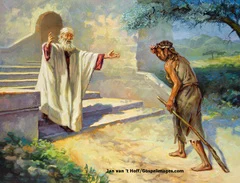
 What should we learn from the story of the prodigal son about sin, forgiveness, repentance, confession, and obedience? What do we learn from the father and the older son about love for the lost, free will, love for brethren, and self-righteousness?
Click to view this material as a Video Bible Study.
Click here to see PowerPoint slides to accompany this study.
Introduction:
In Luke 15 Jesus told three stories in response to a criticism raised against Him.
Scribes and Pharisees complained that He was receiving and eating with sinners (verses 1,2).
In the first story, a sheep became lost. The owner left the ninety-nine sheep that remained to search for the lost one. When he found it, he rejoiced with his friends.
In the second story, a woman lost a coin and searched diligently till she found it. She too rejoiced with her friends.
In the third story, a son rebelled against his father but eventually repented and returned.
Each story teaches that God wants sinners to repent. When they do, there is joy in heaven.
In this study, we seek to learn some lessons from the story of the prodigal son.
The story is never directly explained, but the meaning is clear because of the context.
Lessons Learned from the Younger Son – Verses 11-19
God’s Children Sometimes Fall Away.
Some people teach that it is impossible for a child of God to fall into sin and be lost.
Yet this is exactly what the prodigal did.
Before he went into sin, he was a son of the father (verse 11).
He then wasted his substance in “prodigal” living (verse 13 – NKJV). “Prodigal” means wasteful. ASV says “riotous” living. NASB: “loose living.” The word is elsewhere associated with sexual immorality, drinking and general immorality. (Ephesians 5:18; 1 Peter 4:4)
Verse 30 – He wasted his living with harlots.
This son represents a child of God who leaves the heavenly Father to live in sin.
Other passages show that it is possible for a child of God to sin and be lost.
2 Peter 2:20-22 – Those who escape the defilements of the world but then return to it, are worse off in the end than at the beginning.
Galatians 5:1-4 – A child of God (3:26) can fall from grace. If so, they are severed from Christ, and He profits them nothing.
Acts 8:12-24 – Simon became a child of God, then sinned. He was in the bond of iniquity and would perish unless he repented and prayed for forgiveness.
Many people today turn away from their heavenly Father and choose a path of sin.
Some leave God’s way in their youth.
Some grow up knowing truth but turn from it when they can make their own decisions.
Some live in immorality: fornication, alcohol, drugs, wild parties, gambling, etc.
Others may be morally good but reject the true gospel and the true church. They may be influenced by friends or an unbelieving spouse, or they may pursue material possessions.
Some leave the truth in their later years.
In their middle years, some think, “I’ve never really done what I want.” So they leave the church, leave their family, have an immoral affair, start to party, etc. This is a “mid-life crisis.”
Verses 14-16 – This course led to a crash for the prodigal son.
Sooner or later, sin always leads to some sort of famine.
Some may go into debt, become addicted, go to jail, “friends” and sexual partners may desert them. They have left their family and church, so they have no one. For some the “famine” never comes till after life when it is to late to change.
The case of the prodigal is not unusual.
Returning to God Requires Repentance, Confession, and a Change of Conduct.
Verses 17-19 – The prodigal recognized his sin and humbly repented.
He “came to himself.” Before this he was not really himself. He was “beside himself.” He was “not in his right mind.” He was accountable but not the person he ought to have been.
To solve his problem, he consciously recognized his sin and decided to change and return to serve his father. This decision is called “repentance.”
Verses 7,10 – There is joy in heaven when a sinner “repents.”
Acts 2:38 – Sinners outside Christ must repent and be baptized.
Acts 8:22 – Erring children of God must repent and pray for forgiveness.
2 Corinthians 7:10 – Godly sorrow works repentance unto salvation. Repentance must be motivated by sincere grief and a sense of unworthiness: “I am no more worthy to be called thy son” (verse 19). True repentance brings one to this stage of humility. (Acts 17:30)
God offers forgiveness to all. Receiving forgiveness requires us to humbly recognize our wrong and decide to change. If pride and stubbornness keep us from changing, they will also keep us from forgiveness.
He said, “I am not worthy to be your son. Make me as one of your servants.” When you realize you are not worthy to be a son but are willing to be a servant, God accepts you as a son.
Verses 18,21 – The prodigal openly confessed his guilt.
He said, “Father, I have sinned against heaven and in your sight.” It is not enough just to confess sins to people we wronged nor just to God. We must correct out errors with both.
Psalms 38:18 – I will declare my iniquity; I will be in anguish over my sin.
1 John 1:9 – If we confess our sins, He is faithful and just to forgive us our sins and to cleanse us from all unrighteousness. (Acts 8:22)
Matthew 5:23,24 – If a brother has something against us, we must go and make it right. (Luke 17:3,4; James 5:16)
Many ignore their sin, deny it, excuse it, belittle it, or blame others for it – anything but confess it and change – yet they want to be treated as though they are innocent. When we are guilty and need forgiveness, God says we must admit our error and determine to change.
Verses 18-21 – The prodigal met the conditions of forgiveness and changed his life.
He left his sin, arose, went to his father, and expressed his willingness to serve Him.
Acts 26:20 – One must not only repent, he must do works worthy of repentance.
Proverbs 28:13 – He who covers his sins will not prosper, but whoever confesses and forsakes them will have mercy.
Like the prodigal son, a person in error must realize that the cause of his problem is sin. He must then meet the conditions of forgiveness and change his life.
Lessons Learned from the Father – Verses 20-24
God Wants His Children Saved and He Rejoices When They Repent.
This is a major point in the context. The Pharisees were indifferent to sinners and even criticized one who was trying to save them. In contrast, God cares about sinners and wants them to repent. God’s people should feel the same.
The father was concerned about his son in sin.
Verse 20 – He saw him coming afar off, had compassion, and went to express his love.
Verses 22-24 – The father greatly rejoiced at the son’s return and bid others do the same.
Verses 19,21 – The son asked only to be a servant, but the father treated him as a son (verse 24).
The other stories in Luke 15 teach the same lesson.
Verses 4,8 – When the sheep and coin were lost, the owners went to find them.
Verses 5,6,9 – When the lost was found, the owners rejoiced and urged others to rejoice.
Verses 7,10 – Likewise, God rejoices and wants us to rejoice when His children repent.
Other Scriptures teach the same.
Mark 16:15,16 – God made a plan whereby sinners could be saved, then He arranged for that plan to be communicated to all people. God did not wait for people to come to Him. He initiated the plan and took it to sinners.
2 Peter 3:9 – God is longsuffering because He does not want any to perish. He could justifiably destroy us all, but instead He waits patiently for our repentance.
John 3:16 – His love is so great that His own Son died as our sacrifice. (Romans 5:6-10)
The father had been deeply wronged. He might have been bitter and vengeful. But because of his love, he did not dwell on the wrong but on the repentance. He rejoiced in the son’s return. We should view this as God views it. This is Jesus’ lesson to the Pharisees.
God Allows People to Choose Whether or Not to Serve Him.
God has given people the power of free will.
The younger son had the power to choose to leave home and live in sin. Then he had power to choose to return (verses 13,18,20).
Some people say each person is unconditionally predestined to eternal life or destruction. God chooses some, regardless of their choice or conduct, and compels them to be saved. Others He leaves to be condemned regardless of their choice or conduct.
The case of the prodigal shows the father allowed the son to choose to sin or to return.
Other Scripture confirms that God allows people the choice to serve Him or not.
But our eternal destiny depends on the choice we make.
Joshua 24:15 – Choose you this day whom you will serve.
Revelation 22:17 – The Spirit and the bride invite, but whosoever will may come.
Mark 16:15,16 – The gospel is for all, but whoever believes and is baptized will be saved.
God is no respecter of persons (Romans 2:6-11; Acts 10:34,35). He wants all to be saved, but He does not compel us against our will. He created us the with power to choose. He appeals to us through the gospel, He warns us of the consequences, then He allows us to choose.
God Allows People to Suffer the Earthly Consequences of Sin.
Verse 16 – The prodigal suffered for his sin, but “no man gave him anything.”
The father knew all along the son was in sin (verse 24). But so long as the son refused to repent, neither the father nor anyone else shielded him from the consequences of his sin.
Then he came to himself (verse 17). This helped bring him to repentance.
2 Thessalonians 3:10 – If a man will not work, do not let him eat. Do not bail him out, but let him suffer the consequences of his wrong.
Many people do not learn from instruction.
Despite being warned, some stubbornly do wrong anyway. Sometimes other people think the loving thing to do is to protect people from the consequences of their wrong. But that just enables them to continue in sin. If they are allowed to suffer as a result, they may learn better.
If a young person is old enough to support himself but will not get a job, his family should refuse to feed him. Make him work or do without. (2 Thessalonians 3:10)
If he wastes his money foolishly or sinfully, do not provide more.
If he sins and members of the church rebuke him, do not defend or protect him.
Sometimes people have to hit bottom before they look up. Suffering the consequences of sin in this life can teach people some important lessons.
Remember the prodigal son. As long as someone continues to do wrong, let them suffer for it. But when they repent, that is the time to receive them back with joy.
Lessons from the Older Son – Verses 25-32
Verse 11 – The father had two sons. Verse 25 begins to discuss the older son. The ultimate lesson compares this older son to the Pharisees. Consider this son’s errors.
He Was Unloving toward the Lost.
He lacked love for his brother.
Verses 29,30 – He resented and was jealous of the Father’s goodness and kindness to his brother: “You never did that for me.”
1 Corinthians 13:1-3 – Even great acts of service are unacceptable if not done with love.
He did not seek the salvation of the lost.
1 Timothy 2:4 – God wants all to be saved.
1 Timothy 2:6 – Jesus died for all men.
Titus 2:11 – God’s grace is extended to all.
2 Peter 3:9 – God wants all to repent.
Mark 16:15,16 – So the gospel should go to all.
Many Christians are indifferent to the fate of lost souls. Like the Pharisees, they do not care enough about the lost to teach them the truth. Worse yet, they criticize those who are trying to save the lost.
He Was Unforgiving.
This is Jesus’ point regarding the Pharisees.
Verses 28-32 – Instead of rejoicing that the younger son had repented, the older son was angry and resented the joy of the father and servants. This can happen in the church.
Some are unwilling to forgive those who sin against them personally.
Matthew 6:12,14,15 – God will not forgive us if we do not forgive others.
Matthew 18:21-35 – We must we willing to forgive 70 times 7. God must forgive us many times if we ever receive eternal life. How then can we refuse to do the same for others?
Some are unwilling to forgive people who sin against God.
The Pharisees thought certain people were so sinful they should not associate with them even to bring them to repentance. Later, Jewish Christians thought Gentiles should not be converted to the gospel. (Luke 15:2; 5:29-32; 7:37-50; Acts 10,11)
So today, many people think they deserve better treatment than other sinners who repent. They don’t want to be among bad sinners (thieves, alcoholics, addicts, fornicators, homosexuals, etc.), not even to teach them. If such people repent, some folks still do not want them in the church.
God wants all to be saved, and He rejoices when they repent. We should do the same.
He Was Disobedient and Self-Righteous.
He was disobedient to the father.
Verse 28 – He said he never disobeyed the father. But the father begged him to go and rejoice over his brother’s return, but he would not. This was disobedience.
1 John 5:3; 4:20 – If we say we love God but we hate our brother, we are liars. The older brother said he was faithful to his father but lacked love for his brother. So he really lacked love for the father too.
He was self-righteous.
He thought he never disobeyed, but he failed to how deeply he was in sin.
Luke 18:9-14 – The self-righteous Pharisee thought he was good, but failed to see his error while despising the tax collector who was truly penitent.
Such attitudes are based on self-righteousness. This kind of evil is often harder to recognize and correct than the first son’s sins.
When we fully see our own sins as God sees them, then we will see we have much in common with all sinners. We are all hopeless but for the grace of God. So, we should receive all repentant sinners and work together in Christ.onclusion
Where are you in relation to the Father?
Like the prodigal son, have you turned from the Father to live in immorality or error?
Like the older son, are you serving him outwardly but without proper attitudes?
The truth is both sons were in sin and needed repentance. If you are willing to repent, the Father will receive you with joy as He did the prodigal.
(c) Copyright David E. Pratte, 2026; gospelway.com You are free to keep copies of this material on computer and/or in printed form for your own further study. If you have any other requests about the use of this material, please read our copyright guidelines at www.gospelway.com/copyrite.htm. Free Bible Study Lessons, Commentaries, and Workbooks
